Enclosed trailer sizes range from compact 6x12 models to 8.5x20 and larger, and the right one depends on your largest item, your cargo weight and your tow vehicle. To choose, measure your largest item, add about 20 percent for loading room, total your cargo weight, and confirm your tow vehicle can pull the loaded trailer. Most buyers pick a 7-wide trailer between 12 and 16 feet long. Choose 6-wide for light loads or 8.5-wide for UTVs and heavy equipment.
Size is the decision buyers regret most. Go too small and you outgrow the trailer within a year. Go too big and you pay more, burn more fuel and fight with parking and tight turns. This guide shows you how to find the right enclosed trailer size for your cargo, your tow vehicle and your budget, so you can buy once and get it right.
Understanding Enclosed Trailer Sizes
Enclosed trailer size is the combination of width, length and interior height you choose for your cargo. Enclosed trailers are usually sold by outside width (6, 7 or 8.5 feet) and box length (10 to 20 feet or more). A 7x14 is 7 feet wide and 14 feet long on the outside. Each of the three measurements does a different job.
- Width decides how much you can fit side by side and how the trailer feels on the road. It also affects which tow vehicles can handle it comfortably.
- Length decides how much you can fit front to back. It is the number most buyers change when they realize they need more room.
- Height decides whether you can stand inside, stack cargo, fit tall equipment or add shelves and cabinets.
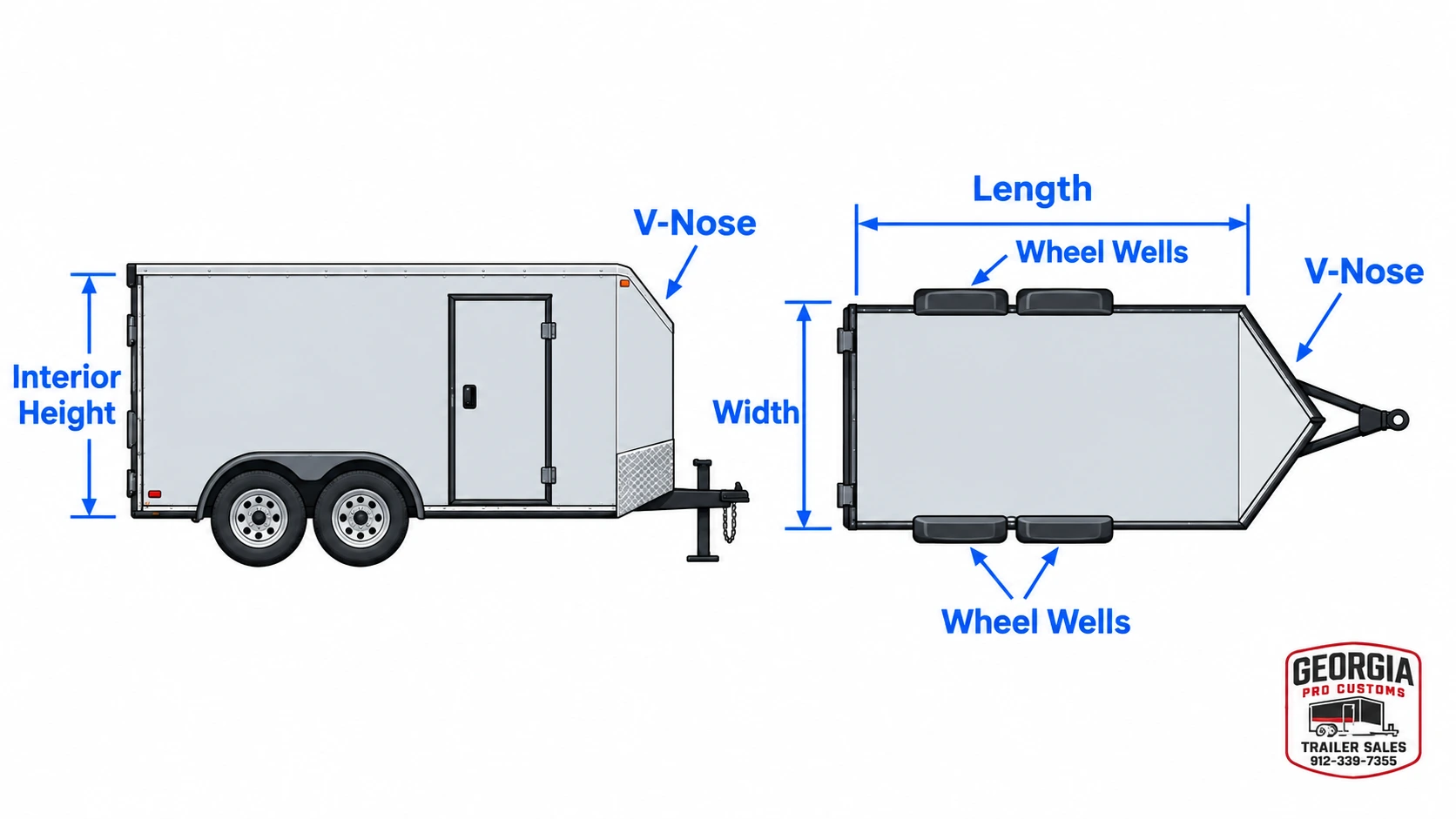
The usable space inside is always a little smaller than the outside numbers. Walls take up room, and wheel wells cut into the floor width. If you plan to carry something wide, like a pallet or a side-by-side, check the width between the wheel wells, not only the wall-to-wall measurement.
Length can also be listed in different ways. Some dealers list the length of the cargo box only, while others include the V-nose or the tongue. A V-nose trailer has a pointed front, and the narrow part is less useful for storage. Ask which one the listing uses so you know how much floor space you really get.
How Do You Measure for the Right Trailer Size?
Measure the length, width, height and weight of your largest item, then add at least 20 percent to the length so you can load and tie down. Add up the weight of everything you carry and compare it to the trailer’s payload. Size the trailer around your most demanding load.
Here is a simple process to follow.
- Write down what you haul, including your biggest load of the year.
- Measure the length, width and height of your largest item.
- Add at least 20 percent to the length for loading and tie-down space.
- Check that the width fits between the interior walls and the wheel wells.
- Check that the height clears the door opening, not only the ceiling.
- Add up the total weight and compare it to the trailer’s payload.
For example, if your longest item is 10 feet, a 12-foot trailer gives you room to work. If you haul two ATVs that are each 7 feet long, you need far more than 14 feet once you count tie-down space and ramp access.
What Is the Most Popular Enclosed Trailer Width?
The 7-wide is the most popular enclosed trailer width. It gives you noticeably more interior space than a 6-wide without the towing demands of an 8.5-wide. It suits contractors, small businesses, landscapers, movers and anyone hauling ATVs or general cargo.
6-Wide Enclosed Trailers
A 6-wide enclosed trailer is best for light loads, small equipment and easy towing. It is compact and light, and many properly rated SUVs and light trucks can pull it. It works well for lawn care gear, hand tools, one or two motorcycles, camping gear and small moves.
Browse our 6-wide enclosed trailers to see what is in stock, or go straight to our 6x12 enclosed trailers.
7-Wide Enclosed Trailers
A 7-wide enclosed trailer is best for most buyers who want more room without a big jump in towing difficulty. It gives you space to store gear along both walls and still walk down the middle. It suits contractors, landscapers, event vendors, ATV owners and one-bedroom moves.
See our 7-wide enclosed trailers ready for pickup or delivery, including popular 7x14 enclosed trailers and 7x16 enclosed trailers.
8.5-Wide Enclosed Trailers
An 8.5-wide enclosed trailer is best for side-by-side UTVs, race cars, mobile workshops and heavy equipment. At 102 inches, it is generally the widest trailer you can tow on U.S. roads without special permits. It needs a properly rated truck and more room to turn and park.
Check out our 8.5-wide enclosed trailers for maximum space, or view our 8.5x16 enclosed trailers.
What Size Enclosed Trailer Do I Need?
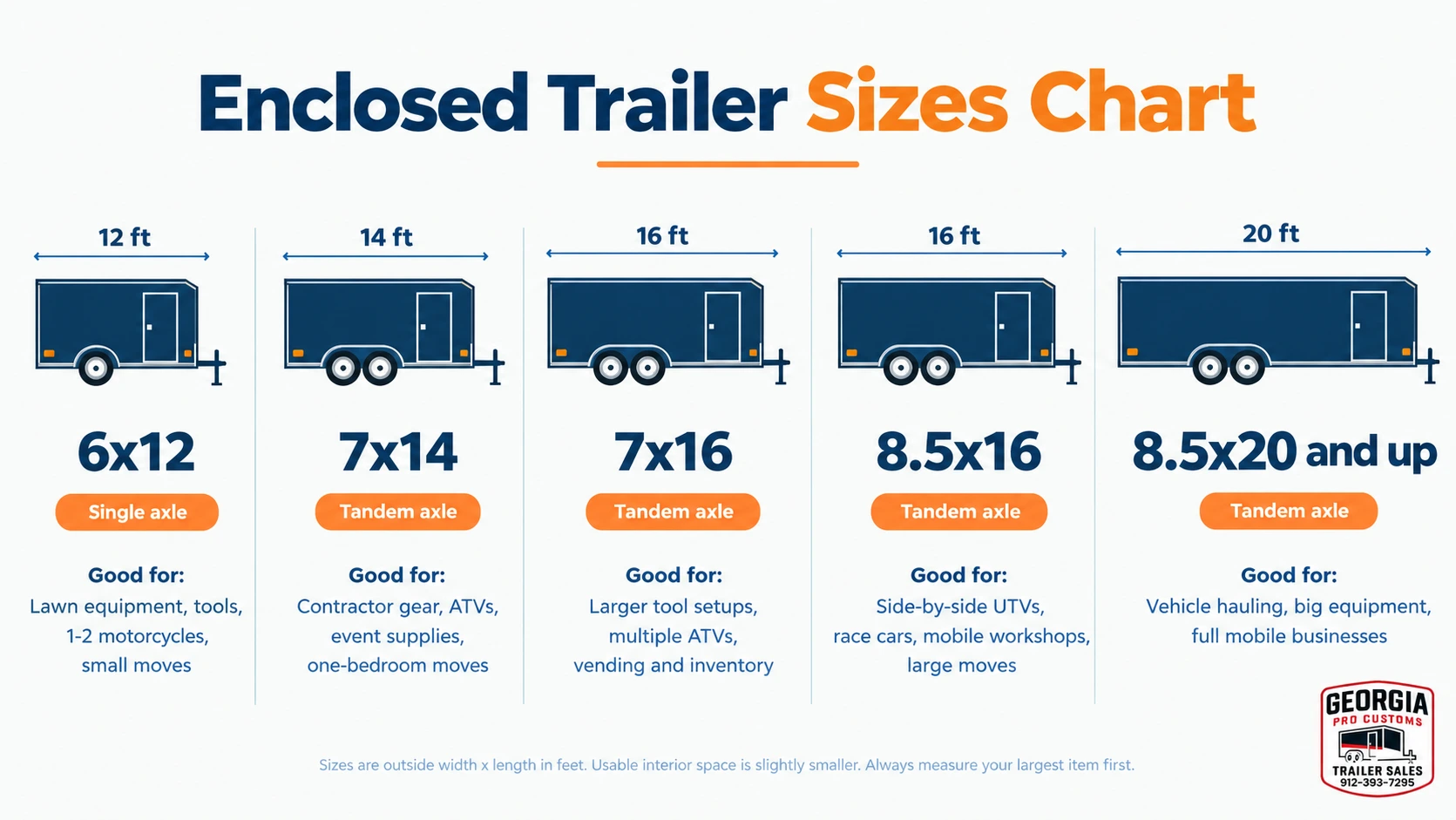
For most people, a 7x14 or 7x16 enclosed trailer is the right size. Choose a 6x12 for tools and light loads, a 7x14 for general work and ATVs, a 7x16 for extra gear or inventory, and an 8.5x16 or larger for UTVs, race cars and mobile workshops.
Use this chart as a starting point for your enclosed trailer size. Your own measurements should always come first.
| Trailer size | Common axle setup | Good for |
| 6x12 | Single axle | Lawn equipment, tools, one or two motorcycles, small moves |
| 7x14 | Tandem axle | Contractor gear, ATVs, event supplies, one-bedroom moves |
| 7x16 | Tandem axle | Larger tool setups, multiple ATVs, vending and inventory |
| 8.5x16 | Tandem axle | Side-by-side UTVs, race cars, mobile workshops, large moves |
| 8.5x20 and up | Tandem axle | Vehicle hauling, big equipment, full mobile businesses |
Choosing the Right Trailer Length
Choose a trailer length that fits your longest item plus about 20 percent for loading room. Here is how each length tends to work in real life.
- 10 to 12 feet: Good for lawn equipment, hand tools, a single motorcycle or a small collection of gear. These trailers are easy to move, store and tow.
- 14 feet: A strong all-around size. It handles contractor tools, a pair of ATVs, event supplies and most one-bedroom moves.
- 16 feet: The step up when 14 starts to feel tight. It gives you room for shelving, a work area, extra equipment or a few more vehicles.
- 18 to 20 feet and longer: Best for hauling vehicles, large equipment, big moves and full mobile businesses. These trailers need a properly rated truck and more room to maneuver.
Remember that loading space counts. If you roll equipment up a ramp, you need clear floor space inside to turn and secure it. If you tie down vehicles or machines, you need room to reach each tie-down point. A trailer that just barely fits your cargo is usually too short in daily use.
Also think about the nose. A V-nose trailer has a pointed front, and the narrow part is less useful for storage. If the listed length includes the V-nose, your usable floor space will be shorter than the number suggests.
If you are stuck between two lengths, go with the longer one. Extra length usually costs far less than replacing a trailer you outgrew.
Interior Height to Consider
Choose an interior height that lets you stand, stack cargo and fit your tallest item through the door. Standard height covers most general hauling. Extra height is worth it if you work inside the trailer, haul tall equipment or plan to add shelves and overhead cabinets. Always check the door opening height too.
Height is the measurement buyers forget most, and it is the hardest one to fix later. Measure the highest point of each item, including roll cages and tool chests, and remember that shelves and overhead storage take height from the usable space. The door opening is often lower than the ceiling, especially with ramp doors. Ask for the exact interior height and whether extra height is available.
Single Axle or Tandem Axle, Which Is Better?
Choose a single axle for light loads and short trips, and a tandem axle for heavier loads, long highway trips and extra stability. Single axle trailers are lighter and cheaper, and they are common on 6x12 sizes. Most 7-wide and 8.5-wide trailers use tandem axles because they carry more weight.
What Are GVWR and Payload?
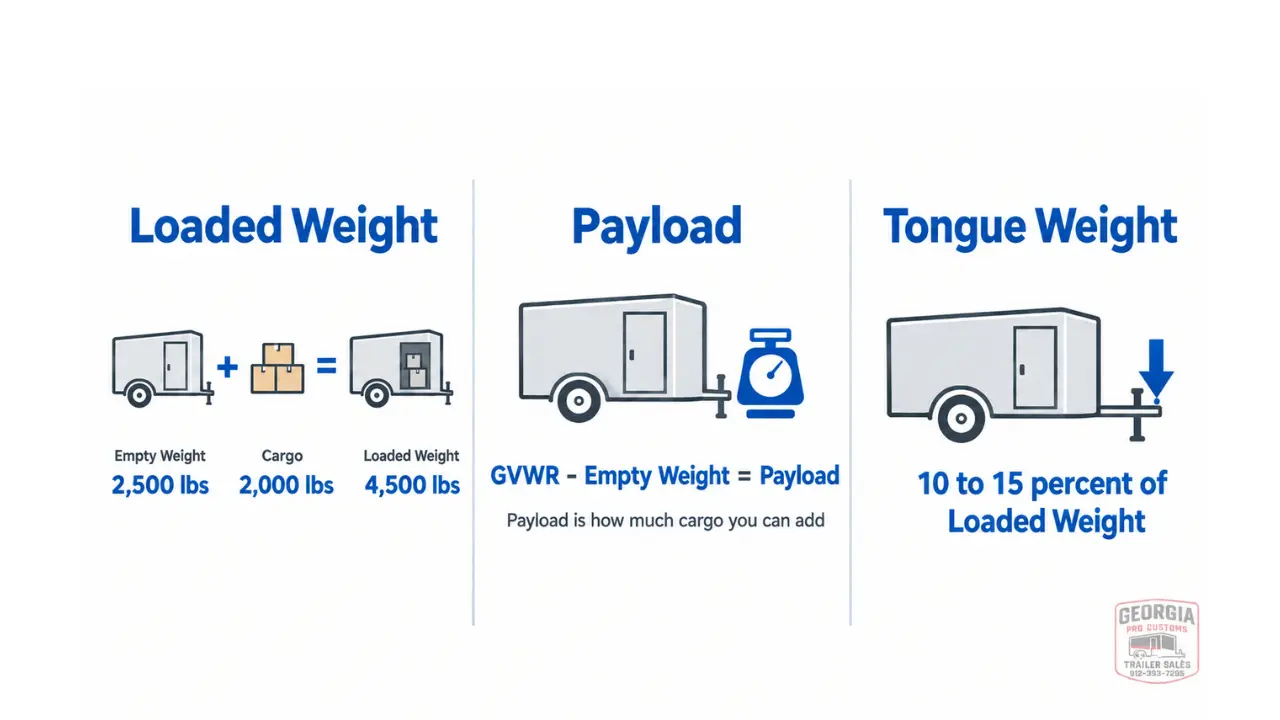
GVWR, or gross vehicle weight rating, is the most a trailer can weigh when fully loaded, including the trailer itself. Payload is how much cargo you can add, which equals GVWR minus the trailer’s empty weight. Your cargo, plus anything you add inside like shelves, must stay under the payload number.
A trailer can fit your cargo and still be too heavy for your plans, so check payload capacity as carefully as you check length and width.
Matching the Trailer to Your Tow Vehicle
Keep the loaded trailer weight safely under your vehicle’s towing capacity, and many people aim for about 80 percent. Also confirm the hitch class, ball size, wiring and brake controller before you tow.
Three checks cover most of it.
- Find your towing capacity in the owner’s manual or on the door jamb label.
- Add the trailer’s empty weight to your cargo weight. For example, a 2,500 pound trailer carrying 2,000 pounds of cargo weighs 4,500 pounds loaded.
- Confirm that the hitch, wiring and brake controller match the trailer.
Tongue weight, the downward force the trailer puts on your hitch, should usually be 10 to 15 percent of the loaded trailer weight. Too little can cause sway. Always go by the numbers in your owner’s manual.
Storage and Parking
Before you buy, measure the driveway, garage or lot where the trailer will live, and check HOA rules. A longer trailer needs a wider turning radius, and an 8.5-wide model needs more clearance. A trailer that does not fit your storage spot quickly becomes a daily problem.
- Security. Park in a well-lit spot and use hitch, wheel and door locks.
Doors and Features That Affect Size
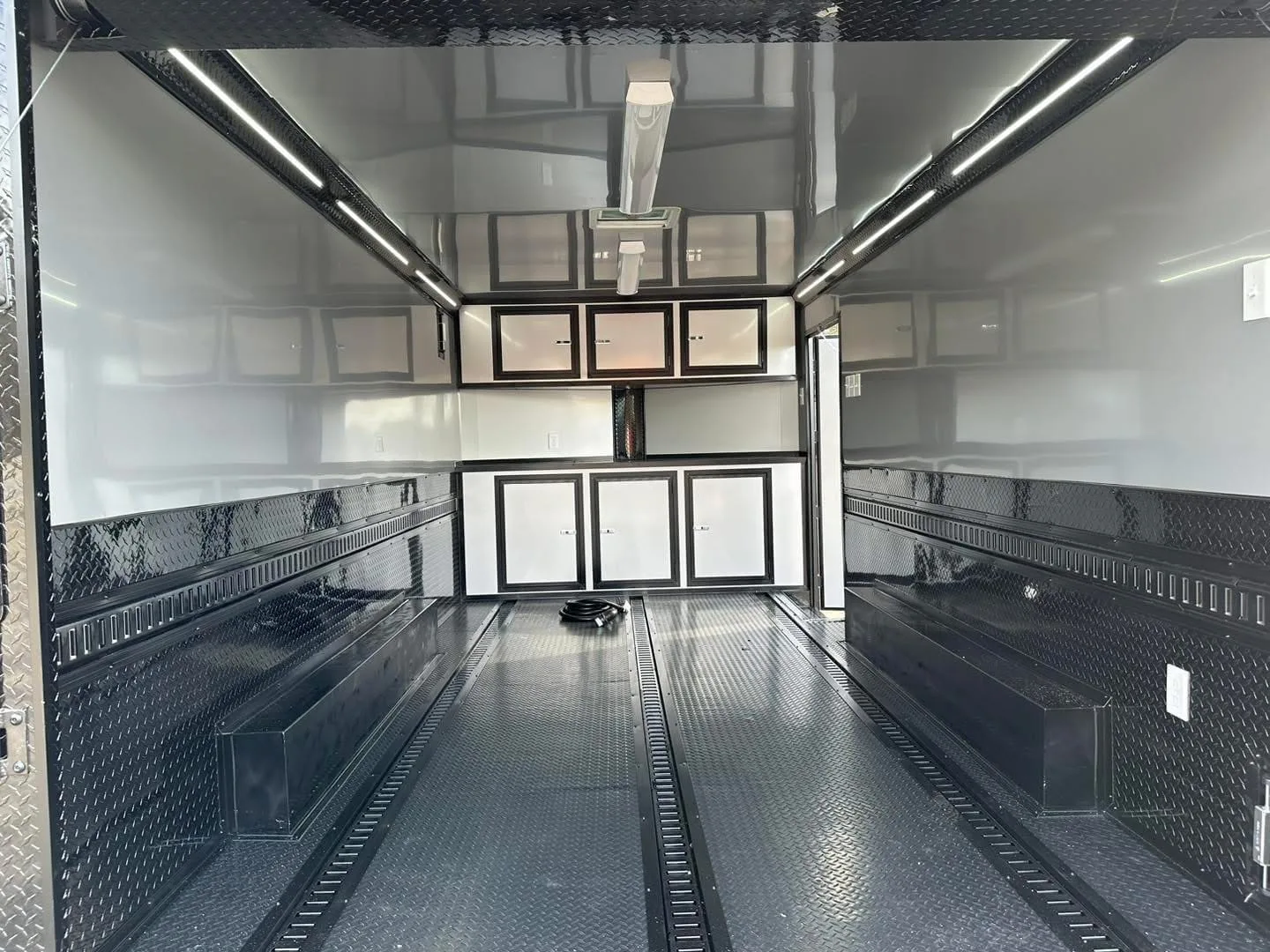
Choose doors and features based on how you load and work. A ramp door suits vehicles and heavy gear, barn doors suit forklifts and pallets, and a side door gives easy access. Cabinets, shelves and lighting add function but also weight, so factor them into your size and payload.
Plan these early, because they change both layout and weight. Ramp doors need clearance behind the trailer, cabinets, shelves and lighting take floor and wall space and add weight, and upgraded axles or tires can raise the weight rating. You can see everything that is available on our custom enclosed trailer options page.
When a Custom Build Makes Sense
Order a custom build when no standard size fits your cargo, equipment or business layout. A custom build lets you set your exact enclosed trailer size, plus axles, doors, cabinets and finish, from the start. It is common for race setups, mobile workshops, concession businesses and anyone with unusual equipment sizes, a need for extra height or a heavier weight rating, or plans to add gear later. The more detail you share about your cargo and tow vehicle, the closer the final trailer will match your needs.
To get started, visit our Build Your Trailer page. For ideas, look through past projects in our custom enclosed trailer gallery.
Best Trailer Size by Use
The right enclosed trailer size depends on what you haul. Here is a closer look by use.
- Lawn care and landscaping: A 6x12 or 7x14 holds mowers, trimmers and blowers. If you haul soil, rock or debris, a dump trailer may suit you better.
- Contractors and trades: A 7x14 or 7x16 gives you space for tools, materials and shelving. See our contractor enclosed trailers.
- Motorcycles: A 6x12 fits one or two bikes. For three or more, step up to a 7x16 or larger.
- ATVs and UTVs: A 7x14 or 7x16 fits most ATVs. Side-by-sides usually need an 8.5-wide trailer. Explore our ATV and UTV enclosed trailers.
- Racing: Race cars and karts need extra length and width, plus room for tools and spares. See our race trailers.
- Moving: A 7x14 handles a small apartment. A 7x16 or 8.5x16 suits larger homes.
- Food and vending: A concession trailer is built around serving windows, equipment and workflow.
- Small business and mobile shops: A 7x16 or 8.5x16 gives you room for inventory, equipment and a work area.
Common Sizing Mistakes
Avoiding these errors helps you pick a size that fits your cargo, your vehicle and your driveway for years.
- Buying for today only: Plan for the next one to two years.
- Ignoring weight: Your cargo may fit while the total still exceeds what your truck can tow.
- Forgetting wheel wells: They cut into usable floor width.
- Skipping interior height: You may not be able to stand or stack cargo.
- Overlooking storage: A large trailer is no help if it will not fit where you park.
- Choosing by price alone: A cheap trailer that is too small costs more in the end.
State Trailer Rules to Check
Trailer rules vary by state, so if you tow across state lines, check each state’s rules with the local DMV before you travel.
Rules most often differ on registration and titling, trailer brakes above a certain weight, lighting and safety chains. If you buy from out of state, ask the seller what paperwork you will receive and check what your home state needs to register the trailer.
Financing and Nationwide Delivery
Georgia Pro Customs offers trailer financing for many credit types and nationwide trailer delivery from its Douglas, GA lot. That means you can buy the enclosed trailer size you actually need instead of settling for a smaller trailer, and you do not have to live near Georgia to order.
Financing spreads out the payments, and delivery means you can order the right size without a long trip. You can also pick up in person in Douglas.
Learn more on our financing page and our nationwide delivery page. You can also shop by brand, including Titanium Cargo trailers, Xtreme Cargo trailers and Anvil trailers.
FAQ
What is the most common enclosed trailer size?
A 7x14 or 7x16 is the most common enclosed trailer size for contractors, ATV owners and general hauling. If you are unsure, start with a 7x14 enclosed trailer and move up to a 7x16 if you need more room.
What are the standard enclosed trailer widths?
Enclosed trailers come in 6, 7 and 8.5 feet wide. At 102 inches, 8.5 feet is generally the widest legal width on U.S. roads without special permits.
What size enclosed trailer do I need for two ATVs?
A 7x14 or 7x16 works for two ATVs, depending on how much tie-down and ramp space you want. If you also carry gear, choose the longer size.
What size enclosed trailer fits a side-by-side UTV?
Most side-by-sides need an 8.5-wide trailer, usually 16 feet or longer. Check the width between the wheel wells before you buy.
Should I choose a single axle or tandem axle?
Choose a single axle for light loads and short trips. Choose a tandem axle for heavier loads, long highway trips and extra stability.
How do I know if my vehicle can tow an enclosed trailer?
Add the trailer’s empty weight to your cargo weight, then compare the total to your vehicle’s towing capacity. Many people aim to stay at about 80 percent of the limit.
Can I order a custom enclosed trailer size?
Yes. If no standard size fits your cargo or business, you can build your trailer with your exact width, length, height, axles and doors.
Final Thoughts
Choosing the right size comes down to a few simple steps. Know what you haul, measure it, add room to work, check the weight and make sure your vehicle can handle it. Once you have those numbers, the right enclosed trailer size is easy to spot.
Ready to find yours? Browse our in-stock enclosed trailers, start a custom trailer build, or contact our team for a quote today.
https://addlinks.pro/gaOa7