
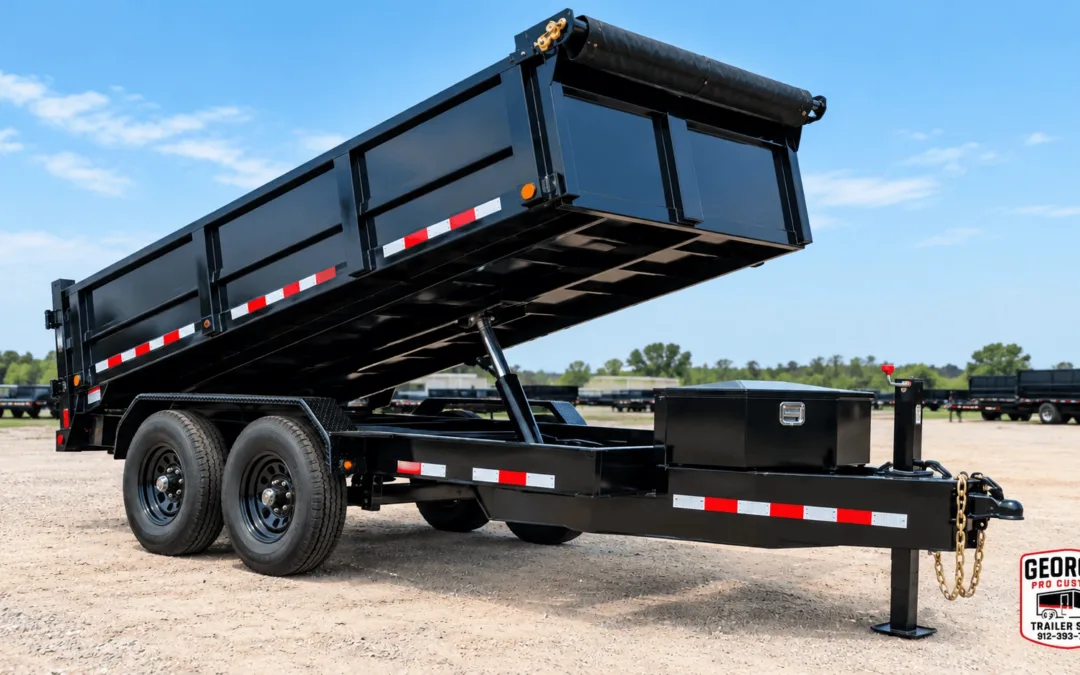
Buying the wrong size dump trailer is one of the most expensive mistakes first-time buyers make. Go too small, and you’re stuck making extra trips, burning fuel, and stretching jobs out longer than they need to take. Go too big, and you’re paying more upfront, towing more trailer than your truck can comfortably handle, and fighting to store and maneuver something oversized for the work you actually do.
The right dump trailer size isn’t about picking the biggest one on the lot or the cheapest one in your budget. It comes down to what you haul most often, how heavy those loads really are, and whether your tow vehicle can safely handle it. This guide walks through every factor that matters, so you end up with a dump trailer sized for your work, not just your wallet.
What Size Dump Trailer Do I Need?
Most homeowners do well with a 5x8 or 5x10 dump trailer. Landscapers and property maintenance crews usually choose a 6x10 or 6x12. Contractors and remodelers typically need a 7x12 or 7x14, and heavy commercial work calls for a 7x16. Whatever the bed size, always check the trailer’s GVWR and payload against your heaviest realistic load and your tow vehicle’s rating.
Start With What You Actually Haul
Before looking at a single size chart, get specific about your typical job. A homeowner clearing yard waste a few times a year has completely different needs than a contractor hauling gravel five days a week. Ask yourself:
- What material do you haul most often: loose debris like mulch and brush, or dense material like dirt, gravel, and concrete?
- How heavy is a typical load, and how heavy is your heaviest realistic load?
- How often will you use the trailer: daily commercial work, or occasional weekend projects?
Dense materials like gravel, wet soil, and concrete hit a dump trailer’s weight limit long before they fill the bed. A trailer that looks half-empty can already be at its maximum safe capacity if you’re hauling crushed stone. Volume and weight capacity are two very different things.
If your work involves hauling tools or equipment rather than loose material, our enclosed trailer sizes guide may be a better fit.
Common Dump Trailer Sizes and What They’re Built For
Dump trailer sizes are measured by the inside bed dimensions, length and width, which tells you how much usable floor space you have. Most buyers land in one of four general categories:
| Trailer Size | Typical GVWR | Approx. Payload | Best For | Typical Users |
| 5x8 / 5x10 | 5,000-7,000 lbs | 3,000-5,000 lbs | Yard cleanup, mulch, small DIY projects | Homeowners |
| 6x10 / 6x12 | 7,000-10,000 lbs | 5,000-7,500 lbs | Landscaping, property maintenance, topsoil | Landscapers, small contractors |
| 7x12 / 7x14 | 12,000-14,000 lbs | 8,000-10,000 lbs | Construction debris, gravel, compact equipment | Contractors, remodelers |
| 7x16 | 14,000-16,000 lbs | 9,000-11,000 lbs | Heavy commercial hauling, demolition, excavation | Construction crews, excavators |
Payload figures are approximate and vary by build, so confirm them against the actual specs on each trailer.
5x8 and 5x10 Dump Trailers
These are among the smallest dump trailers commonly sold, built for occasional, light-duty use. Their single-axle frames make them easy to maneuver into tight driveways and backyards, and most can be towed by a properly equipped half-ton truck or a large SUV. For homeowners handling yard waste, mulch deliveries, and small renovation cleanups, this size covers the job without unnecessary bulk or cost. Browse our 5x10 dump trailers to see what’s available.
6x10 and 6x12 Dump Trailers
For a lot of buyers, this range hits the sweet spot. A 6x10 or 6x12 dump trailer is long enough for pallets and general material, with enough capacity for regular landscaping and property maintenance work without becoming cumbersome. You’ll find both single and tandem axle versions here; tandem axles add stability and payload capacity, which matters if you’re regularly hauling denser material like topsoil or gravel.
7x12 and 7x14 Dump Trailers
Stepping up to a 7-foot-wide dump trailer is where serious work capacity begins. A 7x14 is one of the most popular sizes among contractors handling roofing tear-offs, concrete removal, and compact equipment like mini skid steers. Most trailers in this range run tandem axles rated at 7,000 pounds each, for a combined 14,000-pound GVWR, enough to haul several tons of aggregate in a single trip. If you're shopping this size range, you can browse current dump trailer inventory here to compare available 7x12 and 7x14 bumper pull models.
7x16 Dump Trailers
A 7x16 dump trailer is built for high-volume commercial work: demolition, excavation, and heavy equipment transport. With GVWRs typically in the 14,000 to 16,000-pound range, this size handles the densest materials and largest loads a bumper pull dump trailer can manage. A busy excavation crew will put every inch to use, while a remodeler hauling debris a few times a week might find a 7x14 easier to store and maneuver without giving up much real capacity. Compare options on our 7x16 dump trailers page.
GVWR and Payload Capacity Matter More Than Size Alone
This is the most misunderstood concept in dump trailer shopping, and getting it wrong is an expensive mistake. Two dump trailers with identical bed dimensions can have very different real-world hauling capacities, and the difference comes down to two numbers every buyer needs to understand.
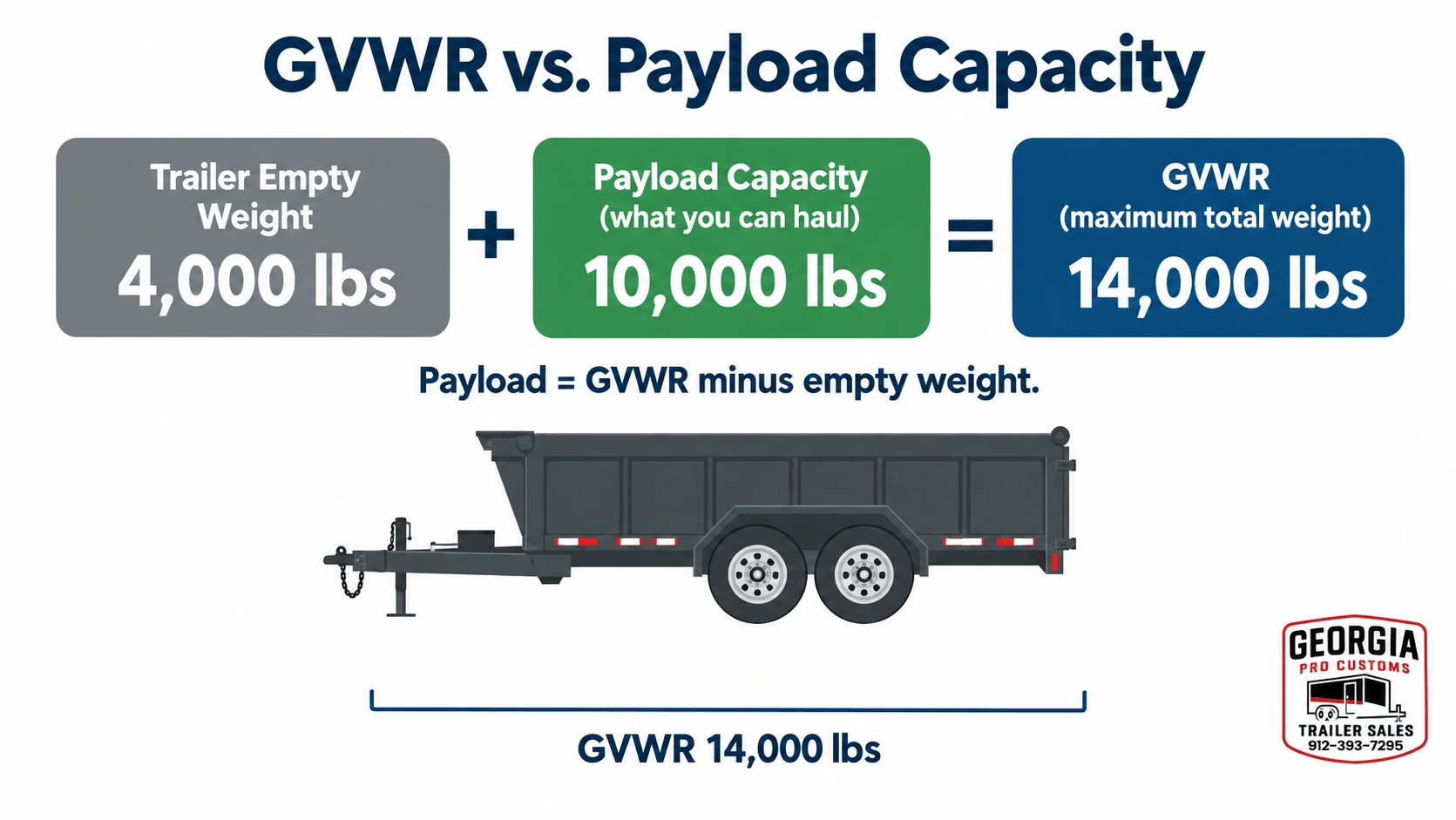
- GVWR (Gross Vehicle Weight Rating) is the maximum total weight the trailer can safely carry, including the weight of the trailer itself.
- Payload capacity is what you actually get to haul. Calculate it by subtracting the trailer’s empty weight from its GVWR.
For example, a dump trailer with a 14,000 lb GVWR and an empty weight of 4,000 lbs gives you a payload capacity of 10,000 lbs, not 14,000. A bigger-looking trailer doesn’t automatically mean more cargo capacity. Always ask for both numbers before buying.
Dump Trailer Capacity in Cubic Yards
Buyers often shop by cubic yards, especially when ordering material. To estimate bed capacity, multiply length x width x wall height (all in feet) and divide by 27. The table below shows level-fill capacity by wall height.
| Bed Size | 24" Sides | 36" Sides | 48" Sides |
| 5x8 | 3.0 cu yd | 4.4 cu yd | 5.9 cu yd |
| 5x10 | 3.7 cu yd | 5.6 cu yd | 7.4 cu yd |
| 6x10 | 4.4 cu yd | 6.7 cu yd | 8.9 cu yd |
| 6x12 | 5.3 cu yd | 8.0 cu yd | 10.7 cu yd |
| 7x12 | 6.2 cu yd | 9.3 cu yd | 12.4 cu yd |
| 7x14 | 7.3 cu yd | 10.9 cu yd | 14.5 cu yd |
| 7x16 | 8.3 cu yd | 12.4 cu yd | 16.6 cu yd |
Volume is only half the picture, because material weight decides how much of that space you can actually use. These approximate weights per cubic yard show why:
| Material | Approx. Weight per Cubic Yard |
| Mulch | 400-800 lbs |
| Topsoil (dry) | 2,000-2,500 lbs |
| Gravel / crushed stone | 2,500-3,000 lbs |
| Wet soil or clay | Up to 3,000 lbs |
Weights vary by moisture and material type, so confirm with your supplier.
At roughly 2,500 to 3,000 pounds per yard, a 10,000 lb payload is reached at about 3.3 to 4 yards of gravel, roughly a third of a 7x14 bed with 36-inch sides.
Make Sure Your Tow Vehicle Can Handle It
Your truck’s tow rating represents the maximum weight it can safely pull, fully loaded, not just the empty trailer’s weight. A common and dangerous mistake is matching your truck’s tow rating to the trailer’s GVWR with no room to spare. If your truck is rated for 10,000 pounds and you buy a dump trailer with a 10,000-pound GVWR, you’re already at your limit before loading a single pound of material.
Tongue weight matters too. Dump trailers load heavy at the hitch, and that downward force counts against your truck’s payload capacity, not just its tow rating. Check both numbers in your owner’s manual.
- Half-ton trucks (Ford F-150, Chevy Silverado 1500, Ram 1500) typically tow between 9,000 and 13,000 pounds depending on configuration, pairing well with the lighter dump trailers in the 5x8 to 6x12 range, as long as the trailer’s GVWR stays safely under your truck’s tow rating.
- Three-quarter-ton trucks (F-250, Silverado 2500, Ram 2500) handle 12,000 to 20,000 pounds, making them a better match for regular hauling with 7x12 and 7x14 dump trailers.
- One-ton trucks (F-350, Silverado 3500, Ram 3500) provide the stability, braking power, and payload capacity needed for 7x16 trailers and heavy commercial work day after day.
Side Wall Height: Volume vs. Weight
Bed dimensions tell you floor space, but wall height determines how much material you can pile in before spilling over. A dump trailer with 24-inch sides holds noticeably less material than the same trailer with 48-inch sides, but that’s not automatically a disadvantage.
- 24-inch sides: Easier loading, better suited to dense materials and equipment where weight, not volume, is the limiting factor.
- 32-inch sides: A good middle ground for mixed-use hauling.
- 36-inch sides: A popular choice for landscaping materials.
- 48-inch sides (or taller, with extensions): Maximum volume for bulky but lightweight loads like brush, mulch, or firewood.
Taller walls don’t increase a trailer’s GVWR. Crews loading a dump trailer with five-foot sides often can’t see over the top, making it easy to keep piling material well past the trailer’s safe carrying capacity. If you need more capacity, the better fix is a trailer with heavier-duty axles and a higher GVWR, not simply taller sides. Some trailers offer removable side extensions, giving you flexibility without locking into one configuration.
Axle Configuration: Single, Tandem, or Dual Tandem
Your axle setup determines how much weight the dump trailer can safely carry, how stable it feels on the road, and how long it will hold up under regular use.
- Single axle dump trailers suit homeowners and light-duty work, hauling mulch, brush, and occasional cleanup jobs. They’re lighter, easier to tow, and simpler to maneuver, especially with smaller trucks and SUVs.
- Tandem axle dump trailers are the most popular choice for contractors, landscapers, and property owners hauling heavier materials regularly. Two axles improve weight distribution, towing stability, braking performance, and overall durability compared to a single axle setup.
- Dual tandem axles, riding on eight tires instead of four, spread weight across a larger footprint for the heaviest commercial jobs: construction, excavation, and municipal hauling where maximum durability matters every day.
Bumper Pull vs. Gooseneck
Most dump trailers sold are bumper pull, connecting to a standard 2-5/16-inch hitch ball on the rear of your truck. This keeps things simple, works with a wider range of tow vehicles, and handles trailers up to roughly 14,000 pounds GVWR comfortably. For most homeowners, landscapers, and contractors, a bumper pull dump trailer covers the job without the added complexity of a bed-mounted hitch.
Gooseneck dump trailers mount their hitch inside the truck bed, directly over the rear axle, improving stability and weight distribution for heavier loads like dirt, demolition debris, and heavy equipment. Goosenecks are generally reserved for larger commercial trailers and require a compatible hitch setup already installed in your truck bed. If your daily hauling tops out in the bumper pull range, compare bumper pull dump trailers across different lengths before deciding.
Lift Type: Scissor vs. Telescopic
The hydraulic lift system is easy to overlook but makes a real difference in how efficiently a dump trailer unloads.
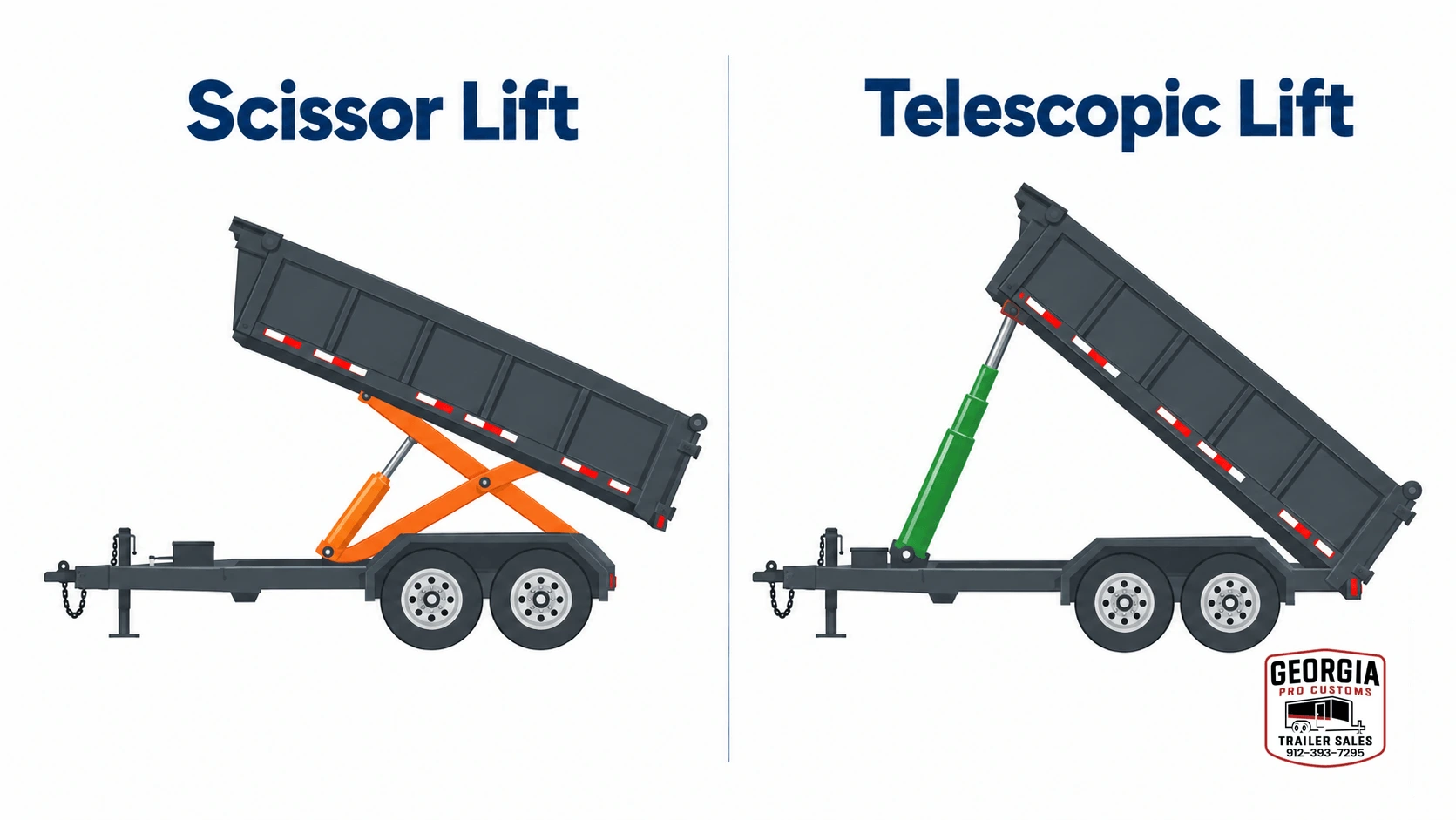
Scissor lifts use a hydraulic cylinder pushing an X-shaped support structure under the bed. They cost less and offer excellent stability thanks to a wider base, especially on uneven ground, but they don’t raise the bed as steeply, so wet soil, clay, or other sticky material may not fully slide out.
Telescopic lifts use a multi-stage hydraulic cylinder mounted at the front of the trailer, raising the bed to a much steeper angle, often around 45 degrees, for faster, cleaner unloading. They cost more but handle wet or sticky material far more effectively, and many contractors consider the extra cost worth it for the time saved on every dump. The main caution is to unload on level ground whenever possible, since the steeper angle puts more weight higher in the air during dumping.
Steel Gauge and Frame Construction
Steel thickness has a major effect on how long a dump trailer lasts under real use. Many budget trailers use thinner 12- or 14-gauge steel to cut manufacturing costs, while heavier-duty trailers use 10-gauge steel walls and flooring that resist dents, handle impacts, and flex less under load. If you’re loading rock, concrete, gravel, or demolition debris regularly, the difference shows up quickly in how the trailer holds up over time.
The frame matters just as much. A heavy-duty I-beam frame distributes weight more evenly and resists twisting better than a lighter channel frame, directly affecting how much payload the trailer can safely support and how long it lasts.
Material choice also plays a role. Steel dump trailers are extremely strong and well suited to heavy materials like rock and concrete, though they weigh more, which eats into payload capacity. Aluminum dump trailers are lighter and rust-resistant, letting you carry more material within the same GVWR, but they typically cost more upfront. For heavy, abrasive material, steel remains the more common and durable choice; if weight savings and corrosion resistance matter more, aluminum is worth the premium.
Common Dump Trailer Sizing Mistakes
Buying the wrong dump trailer size almost always comes down to one of these predictable errors:
- Focusing only on bed dimensions: Two trailers with the same bed size can have GVWRs thousands of pounds apart, and a smaller bed on a heavier-duty frame can out-haul a larger bed on a lighter build.
- Ignoring your tow vehicle’s limits: Your trailer’s GVWR can’t exceed what your truck can safely pull, fully loaded.
- Buying too small to save money upfront: More trips, more fuel, and more wear on your truck and trailer.
- Buying too large “just in case”: Higher cost, a bigger tow vehicle, and harder storage and maneuvering.
- Forgetting about storage and site access: A 7x16 dump trailer doesn’t fit everywhere a 6x10 does.
The best approach is sizing your dump trailer for the work you do most often, not the occasional outlier job that happens once a year.
Towing Regulations Worth Knowing
Trailer brakes are required in most states above a certain GVWR threshold, commonly around 3,000 pounds, though the exact figure varies by state. Because nearly all dump trailers, including 5x8 and 5x10 models, are rated well above that, expect electric brakes and a compatible brake controller in your tow vehicle.
Tarp laws, width limits, and load securement rules also vary by state, and many jurisdictions legally require a tarp over loose material like gravel, dirt, or roofing debris on public roads. Federal rules generally require a commercial driver’s license when the combined weight rating is 26,001 pounds or more and the trailer is rated over 10,000 pounds, though many states exempt non-commercial use. Always verify the rules in your area before committing to a larger dump trailer.
Financing and Delivery
Not sure you can fit the right size into your budget? Explore our financing options, and see how our nationwide delivery works if you’re not nearby. If your hauling needs don’t match a standard configuration, check out our custom trailer options.
Final Thoughts
Choosing the right size dump trailer comes down to matching the trailer to the work you actually do. Start with what you haul most often, understand the real difference between GVWR and payload capacity, confirm your tow vehicle can handle the trailer fully loaded, and then layer in the right axle configuration, wall height, and lift system for your typical job. If you’re ready to compare real options, browse our current dump trailers for sale to see what fits your hauling needs.
FAQ
What size dump trailer should I buy?
Choose a dump trailer size based on what you haul most often, not your occasional largest load. Consider your tow vehicle’s rating, the density of your typical materials, and the trailer’s real payload capacity rather than just its bed dimensions.
What’s the difference between GVWR and payload capacity on a dump trailer?
GVWR is the maximum combined weight of the trailer and everything loaded into it. Payload capacity is what you actually get to haul, calculated by subtracting the trailer’s empty weight from its GVWR.
How many cubic yards is a 7x14 dump trailer?
With 36-inch sides, a 7x14 holds about 10.9 cubic yards at level fill. With 24-inch sides it holds about 7.3, and with 48-inch sides about 14.5.
How much weight can a 7x14 dump trailer hold?
Most 7x14 dump trailers have a GVWR of 12,000 to 14,000 pounds and a payload of roughly 8,000 to 10,000 pounds, depending on the trailer’s empty weight. Check the specs on the exact model.
Can my truck tow a dump trailer?
Your truck’s tow rating must cover the trailer’s fully loaded weight, not just its empty weight. Half-ton trucks generally handle smaller dump trailers, as long as the trailer’s GVWR stays safely under the truck’s tow rating, while three-quarter-ton and one-ton trucks are better matched to 7x14 and 7x16 models.
Do dump trailers need brakes?
In most cases, yes. Most states require trailer brakes above a GVWR threshold of roughly 3,000 pounds, and nearly all dump trailers exceed it. You’ll need electric brakes and a brake controller in your tow vehicle.
Is a telescopic lift better than a scissor lift on a dump trailer?
A telescopic lift reaches a steeper dump angle and clears wet or sticky material more efficiently, while a scissor lift costs less and provides excellent stability for general-purpose hauling.
Do I need a tandem axle dump trailer?
If you haul heavier or denser materials regularly, such as gravel, dirt, or demolition debris, a tandem axle dump trailer offers better stability, braking performance, and payload capacity than a single axle model.